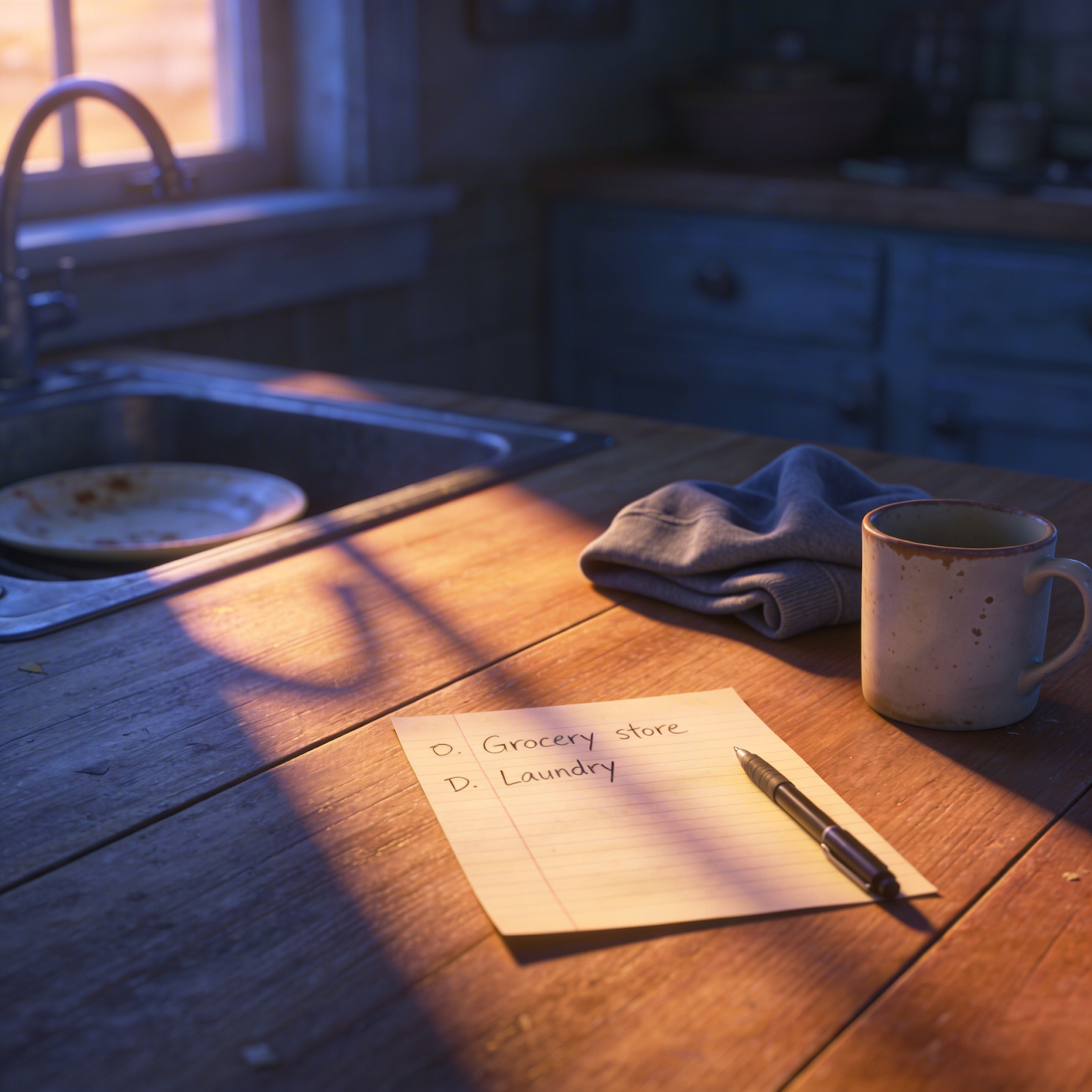
Sunday Reset Routine: The One I Actually Stick To
A slow Sunday reset that actually sticks — three small things, not forty-seven aesthetic steps, and just enough to make Monday feel less jagged.

This is not that. This is a slow Sunday reset that actually sticks — which mostly means it's small enough to survive contact with an actual Sunday.
Then there's the version that actually happens.
Last Sunday I found myself at 4pm with half a to-do list, a cold cup of tea, and a general sense that the afternoon had slipped through my hands while I wasn't looking. I'd managed to wipe down one countertop and change the hand towels in the bathroom. That was it. The dramatic reset I'd been mentally promising myself since Thursday? Still pending. I sat down on the sofa with a vague feeling of having let myself down, which is a fairly bleak way to end a weekend.
For a long time I thought the problem was motivation, or discipline, or the fact that I hadn't found the right system yet. I'd read about Sunday routines that started at 8am and ended with full meal prep and a colour-coded planner for the week ahead. I'd screenshot them, save them, fully intend to start next week. Next week came and went. The screenshots accumulated. The routines did not.
The thing is, the resets I'd been admiring were built for a version of me that doesn't quite exist. The one with clear Sundays and inexhaustible energy and no backlog of things that simply didn't get done last week. The real version of me is a little tired by Sunday. She wants the week ahead to feel manageable, yes, but she also wants to sit down for an hour without the low hum of guilt.
So I stopped trying to reset everything and started asking a different question: what's the smallest version of this that would actually make Monday easier?
It turned out to be three things. Not a list of thirty. Three.
01One — the tidy that actually helps
A quick tidy of one surface, usually the kitchen table. Something about sitting down to breakfast on a Monday morning with a clear surface makes the whole day feel less like I'm already behind. It takes four minutes. Maybe five if I've left a book there again.
On Sunday nights, the house has a way of gathering its own weight. Mail sits in a lopsided stack by the kettle, a pair of shoes is stranded in the middle of the rug, and the kitchen table has become a graveyard for half-finished thoughts — a mug with a tea bag still in it, a receipt from the hardware store, three notebooks I opened with great intention and then abandoned. If I leave them there, they are the first thing I see when I stumble out for coffee at 7:00 AM. And before the kettle has even boiled, my brain is already cataloguing the tasks I didn't finish last week.
So I clear the table. Just the table. I don't touch the mail stack, and I leave the shoes where they are. I wipe down the wood, set a single clean mug out for the morning, and leave it at that. It is a tiny, physical boundary between the weekend that was and the week that is coming.
02Two — the five-minute calendar check
Checking the calendar for the week. Nothing elaborate, just a five-minute scan so nothing blindsides me on Tuesday morning. I used to skip this and then spend Monday in a low-grade panic that I'd forgotten something important. I usually had.
I used to think planning meant sitting down with a ruler and three different colored pens to divide my days into neat, efficient boxes. I would schedule my focus time, my exercise blocks, and my reading hours, creating a beautiful grid that looked like the calendar of an extremely successful person. But by Tuesday afternoon, that grid was always in ruins, shattered by a late email or a dentist appointment I'd forgotten to write down.
Now, the check is just about seeing where the obstacles are. I open the calendar on my phone, look at the meetings already there, and mentally note the days that are going to be loud. If Wednesday is packed from nine to five, I know Tuesday night is not the time to schedule dinner with a friend. I want to see where the chairs are in the room before I turn off the lights, so I don't spend the week bumping into them.
03Three — Monday's clothes, chosen on Sunday
Picking out what I'm wearing on Monday, which sounds almost embarrassingly simple until you've lived through the specific misery of standing in front of a wardrobe at 7:30am feeling quietly wronged by your own clothes. It's two minutes. It is genuinely worth it.
There is a specific kind of morning friction that comes from making choices when you are only half-awake. You pull out a sweater, realize it has a faint tea stain on the sleeve, put it back, try on a shirt that feels slightly too tight today, and suddenly fifteen minutes have vanished while you stand in your socks feeling vaguely defeated by your own closet. It is a minor frustration, but it sets a jagged tone for the whole morning.
So I choose the clothes on Sunday night. I drape a simple cardigan and trousers over the back of the chair, set out a clean pair of socks, and close the wardrobe. When Monday morning comes, there is one less decision to make. It feels like a small gift from the woman I was last night to the tired woman I am right now.
That's it. The whole reset.
It doesn't look impressive on paper. It doesn't photograph well or inspire anyone's Pinterest board. But here's the thing: it actually happens. Every week, without fail, because it's small enough to fit into whatever Sunday I actually have, not the imaginary perfect one.
04Why this is the slow Sunday reset that actually sticks
There's something worth sitting with in that. We design elaborate routines for our best selves — the most rested, most organised, most motivated version — and then feel vaguely like failures when that person doesn't show up. But the reset that works isn't the one you'd do on your best Sunday. It's the one you'll do on the Sunday when you're tired, when the week was hard, when the afternoon disappeared and there's only an hour left before you want to wind down.
I spent years thinking the fix was a better system. A prettier planner. More discipline. But the system was never the problem. The problem was that I kept designing for a woman who has a free Sunday afternoon and a full tank of energy, and then feeling like a failure when I turned out to be someone else entirely — tired, behind, mildly resentful of the lemon situation in the fridge. The three-thing version works because it doesn't need that woman to show up. It only needs me.
When we set the bar at a fifty-step routine, we are telling ourselves that we are only allowed to start the week well if we have the energy to perform. But real life doesn't always offer that kind of energy. A slow Sunday reset that actually sticks is one that honors the reality of being tired. It is the floor, not the ceiling. And having a floor, it turns out, is everything.
05For the rare good Sunday
I'm not against big Sunday resets, by the way. On the rare occasion I have a genuinely free afternoon and the energy to match, I'll do more — a proper clean, batch cooking, the whole performance. But I stopped treating that as the standard. The three-thing version is the floor, not the ceiling. And having a floor, it turns out, is everything.
When you treat the good Sundays as the rule, you spend the bad Sundays feeling like you are falling behind. But if you treat the three-thing reset as the rule, the good Sundays feel like an unexpected luxury. If I have the space to roast a chicken and fold three baskets of laundry while listening to a podcast, that's lovely. But if I only manage to clear the kitchen table and pick out my cardigan for Monday, that is still a complete success. The difference between a floor and a ceiling is that you can stand on a floor every single week. A ceiling is just something you occasionally, briefly, manage to touch.
I’m quietly building something called The Quiet Weekly Reset, a simple printable guide for the Sundays when you want Monday to feel less jagged.
If you want first word when it is ready, stay close through the email list or browse Life in Sync in the meantime.
I read every note. The comment section here is the quietest corner of the internet — come sit.
Leave a note
Comments
Post a Comment